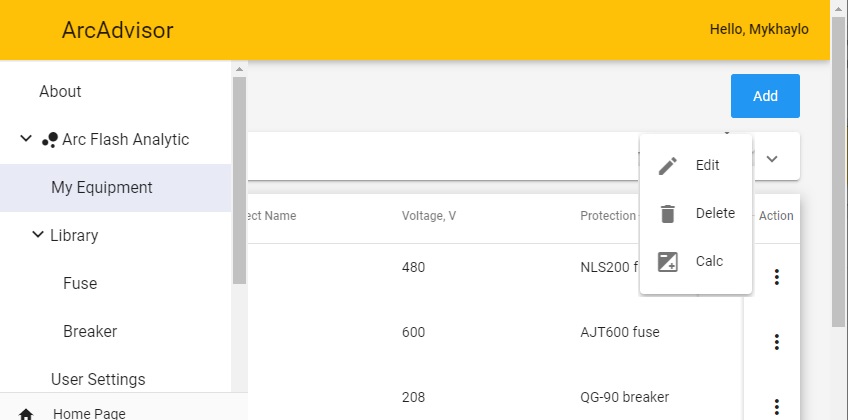
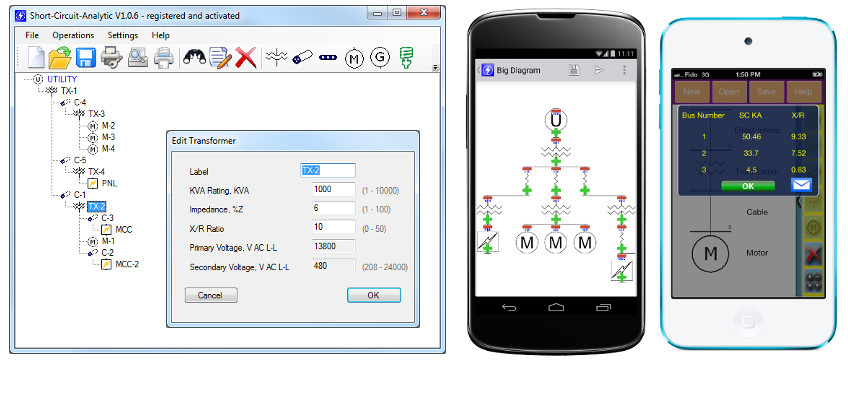

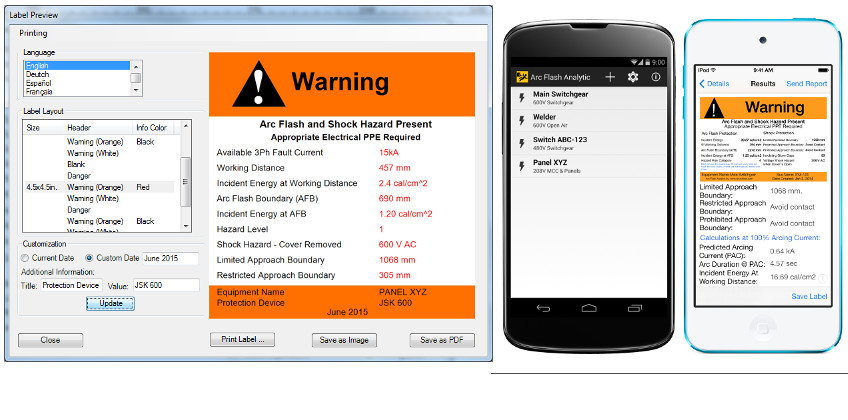
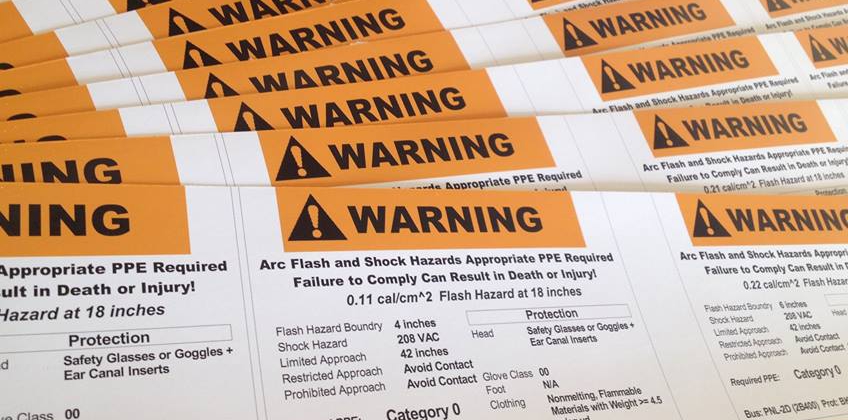














ARCAD helps facilities create safer working environments for individuals who service electrical systems by providing On-Line and PC based software tools for Short Circuit and Arc Flash Hazard Analysis. NFPA requires that any panel likely to be serviced by a worker be surveyed and labeled. ARCAD service includes resources and tools allowing plant and facility managers and personnel to perform short circuit, incident energy, arc flash protection boundary, level of PPE calculations, and create customized arc flash warning labels themselves reducing the cost of obtaining compliance with OSHA, NFPA70E and new Canadian CSA Z462 standards.
Arc Flash and Short Circuit Analysis
IEEE 1584 and NFPA 70E based Arc-Flash-Analytic v 4.1 tool for arc flash hazard analysis ( PC version for Windows 9X, XP, Vista, Windows 7) has been released.
Click the image below to launch video tutorial
Arc Flash Analysis Label Making Software Features
Tutorial demonstrating various Arc Flash Analytic 4.1 program features and settings including units of measurement, label layout, saving labels, calculation results and equipment configuration.
Check also the links below for more product information:
Spend $400 or more on ARCAD stocked products and get Arc Flash Analytic 4.1 software FREE
Must mention ESAVINGS promotional code in comments field upon checkout or by email to sales@arcadvisor.com
Short Circuit Fault Current Calculator
Determining available short circuit fault currents is one of the most important aspects of designing power distribution systems. Short circuits and their effects must be considered in selecting electrical equipment, circuit protection devices, carrying out arc flash analysis. The short circuit calculator presented on this web-site is offered in effort to satisfy the need for a convenient, comprehensive method of calculating three phase distribution system short circuit fault currents. It is intended for radial and looped low voltage (LV) and high voltage (HV) circuits. The calculator allows to quickly and easily obtain accurate potential short circuit currents at each node (bus) in a power distribution system.
A Handbook to Accompany the Online Short-Circuit Calculation Program
We have developed an easy-to-use and comprehensive online tool for calculating arc incident energy, flash protection boundary and risk category required by NEC when work is to be performed on or near the energized equipment. The calculator takes equipment configuration, gap between electrodes, grounding type, short circuit fault current value and system voltage on input, determines arcing fault current, calculates incident energy, arc flash protection boundary, hazard / risk level at the potential point of fault and creates detailed warning label [more...].
Arc Flash Calculator and Warning Label Creator
What makes our short circuit calculator different?
1
First and foremost, ArcAd's short circuit online calculator features input data analysis and hard coded error propagation rules ensuring that the resulting fault current values are not more precise than justified by the accuracy of input data [ more... ]. This is very important but widely ignored issue.
2
Ability to accurately handle motor and generator contributions. Many programs and procedures of this type do not properly account for motor loads as they simply have the user add the motor contribution to the utility source KVA. Some programs make short circuit fault current assumptions based on transformer size etc. This inadvertently distorts short circuit fault current values and blurbs the safety margin. The calculator allows motors and generators to be placed anywhere in the network. The contribution from each motor and the utility source is vectorally added at every point where they intersect. This provides an extremely accurate analysis of the maximum short circuit MVA any node can be subject to.
3
By performing short circuit MVA analysis for positive, negative and zero sequences, symmetrical three phase and unsymmetrical phase to ground, phase to phase, double phase to ground fault currents can be resolved.
The calculator procedure is based on MVA method for solving industrial power system short circuits. Each component of the power system is assigned MVA short circuit rating. For example, the short circuit MVA contribution of the motor is equal to its own MVA base divided by its own per unit impedance. The cable or bus short circuit MVA rating is equal to (kV)2 / Z, where kV is the cable line voltage and Z is cable impedance.
To use the short circuit calculator:
Briefly review the examples and frequently asked questions to see the procedure in action and learn the resource capabilities
Create an account if you don't already have one, and log onto the page where you can add components one by one to build up a radial electrical distribution system. The components can be a power source, transformers, bus ducts, cables, motors and generators, or "special" components whereby the user can define his own X and R values for a non-standard device. Short circuit MVA values contributed both by source and the system equipment are calculated for each portion of the system
Your account gives you the advantage of saving the entered system digram and experiment with other configurations. This is practical for systems with multiple scenarios of interconnections where the system goes through ongoing changes over a period of time. You may continue your analysis without having to re-enter your data from the beginning.
