IEEE 1584 and NFPA 70E based Arc-Flash-Analytic v 3.0 tool for arc flash hazard analysis ( PC version for Windows 9X, 2000, NT, XP, ME, Vista) has been released.
Calculator-style interface makes complex calculations easy to understand.
Provide a safer working environment by specifying the proper level of PPE. Wearing inadequate clothing is dangerous for obvious reasons, but wearing too much clothing is dangerous due to limited mobility and visibility.
Design safer power systems while insuring compliance with NEC 110.16, OSHA, NFPA 70E and IEEE 1584 standards.
Avoid potential fines, lost productivity, and increased insurance and litigation costs.
Save time by generating arc flash warning labels in electronic .JPG and .BMP formats
Customize labels by selecting and adding information displayed on them.
Save results in generic text format for future reference or printing with one button click.
Perform analysis using metric (mm, Joules ), imperial units (inches, calories ), or even a mix of both
Calculate arc blast explosion pressure and arc TNT equivalent
Create warning labels in English, French or Spanish
This is the amount of thermal incident energy to which the worker's face and chest could be exposed at working distance during an electrical arc event. Incident energy is measured in joules per centimeter squared (J/cm2) or calories per centimeter squared (cal/cm2). Minimum reported incident energy is 0.25 cal/cm2 which is the accuracy limit of the test equipment.
The flash protection boundary is an approach limit at a distance from exposed live parts or enclosed live parts if operation, manipulation, or testing of equipment creates a potential flash hazard, within which a person could receive a second degree burn if an electrical arc flash were to occur. A worker entering the flash protection boundary must be qualified and must be wearing appropriate PPE. The Flash Protection Boundary is required to be calculated by NFPA 70E.
This is the minimum level of Personal Protective Equipment in calories per centimeter squared, as evaluated in IEEE Standard 1584, with the intent to protect the worker from the thermal effects of the arc flash at 18 inches from the source of the arc.
Min Incident Energy, cal/cm^2
Max Incident Energy, cal/cm^2
Risk Category
Required Min Rating of PPE, cal/cm^2
0
1.2
0
1.2001
4
1
4
4.001
8
2
8
8.001
25
3
25
25.001
40
4
40
40.001
and above
Not Available
N/A
Recommended Personal Protective Equipment ( PPE )
Risk Category
Personal Protective Equipment ( PPE )
0
Natural fiber ( cotton / wool ) long sleeve shirt & pants, safety glasses, hard hat, V-rated gloves
1
FR shirt and pants, safety glasses, hard hat, V-rated gloves
2
FR shirt and pants, face shield, hard hat, ear canal inserts, V-rated and leather gloves, leather work shoes
3
FR coverall over FR shirt and pants, flash suit hood, ear canal inserts, V-rated and leather gloves, leather work shoes
4
Flash suit over FR coverall over FR shirt and pants, flash suit hood, ear canal inserts, V-rated and leather gloves, leather work shoes
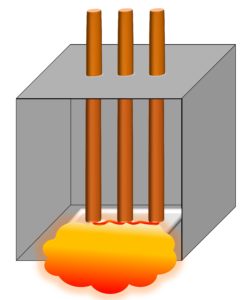
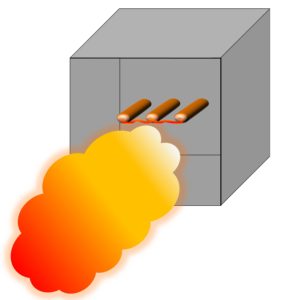
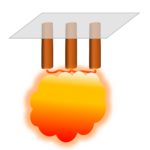
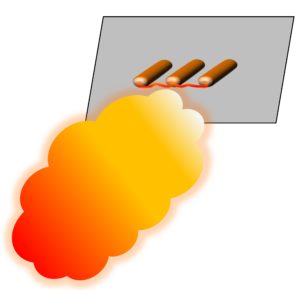
Equipment bus gap in mm. Gaps of 3 to 40 mm were used for low voltage testing to simulate gaps between conductors in low voltage equipment and cables. Gaps 13, 104 and 152 mm. were used in 5 and 15kV equipment testings. For cases gap is outside the range of the Empirical model, the theoretically derived Lee method can be applied and it is now included in the Arc Flash Analytic v3.0.
Two grounding classes are applied in the IEEE 1584 procedure, as follows:
a) Ungrounded, which included ungrounded, high-resistance grounding and low-resistance grounding.
b) Solidly grounded.
Typical working distance is the sum of the distance between the worker standing in front of the equipment, and from the front of the equipment to the potential arc source inside the equipment.
Arc-fash protection is always based on the incident energy level on the person's face and body at the working distance, not the incident energy on the hands or arms. The degree of injury in a burn depends on the percentage of a person's skin that is burned. The head and body are a large percentage of total skin surface area and injury to these areas is much more life threatening than burns on the extremities. Typical working distances are shown in table below:
Use protective device characteristics, which can be found in manufacturer's data. For fuses, the manufacturer's time-current curves may include both melting and clearing time. If so, use the clearing time. If they show only the average melt time, add to that time 15%, up to 0.03 seconds, and 10% above 0.03 seconds to determine total clearing time. If the arcing fault current is above the total clearing time at the bottom of the curve (0.01 seconds), use 0.01 seconds for the time.
For circuit breakers with integral trip units, the manufacturer's time-current curves include both tripping time and clearing time.
For relay operated circuit breakers, the relay curves show only the relay operating time in the time-delay region. For relays operating in their instantaneous region, allow 16 milliseconds on 60 Hz systems for operation. The circuit breaker opening time must be added. Opening times for particular circuit breakers can be verifed by consulting the manufacturer's literature.
Available 3 phase bolted fault current for the range of 700A to 106kA at the point where work is to be performed is entered into this box in kA. Example: if 42,350 amps are available, enter 42.35 into this box. If 16,000 amps are available, enter 16 into this box. You can use our comprehensive online short circuit calculator to determine the available fault currents in your power distribution system.
The arcing current depends on the available 3 phase bolted fault current for the range of 700A to 106kA at the point where work is to be performed, configuration, system voltage and gap between conductors [more...]. Leave the field blank, the program calculates the value based on the system parameters. The arc duration should be determined based on the predicted arcing current.
System Line to Line Voltage for the range of 208V to 15000V is entered into the box in Volts. For cases where voltage is over 15kV, the theoretically derived Lee method can be applied and it is now included in the Arc Flash Analytic v3.0.
For protective devices operating in the steep portion of their time-current curves, a small change in current causes a big change in operating time. Incident energy is linear with time, so arc current variation may have a big effect on incident energy. The solution is to make two arc current and energy calculations; one using the calculated expected arc current and one using a reduced arc current that is 15% lower.
The calculator makes possible both calculations for each case considered. It requires that an operating time be determined for both the expected arc current and the reduced arc current. Incident energy is calculated for both sets of arc currents and operating times and the larger incident energy is taken as the model result. This solution was developed by comparing the results of arc current calculations using the best available arc current equation with actual measured arc current in the test database.